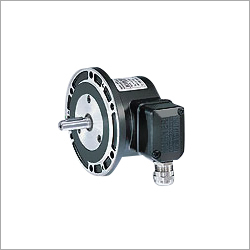
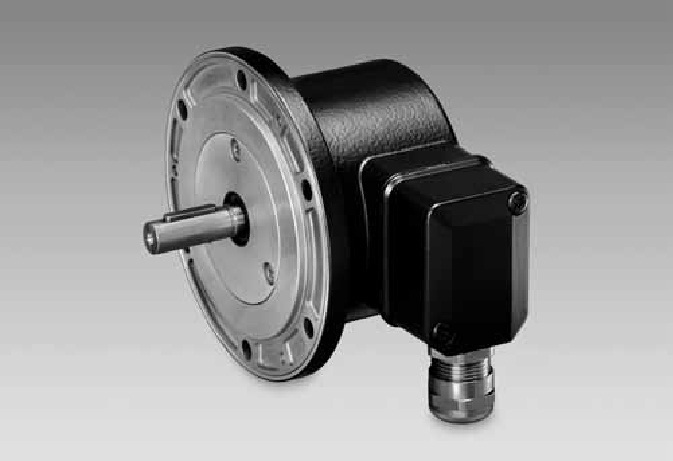
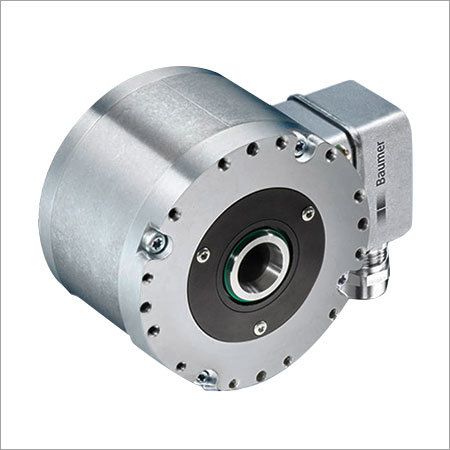
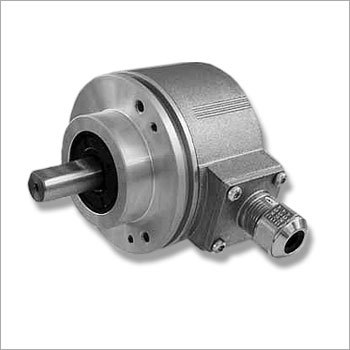
About Incremental Encoder- heavy duty
Incremental Encoder
Technical data - electrical ratings
- Voltage supply 5 VDC 5 %
- 9...26 VDC
- 9...30 VDC
- Consumption w/o load 100 mA
- Resolution (steps/turn) 1...1250
- Phase shift 9020
- Scan ratio 40...60 %
- Reference signal Zero pulse, width 90
- Sensing method Optical
- Output frequency 120 kHz
- Output signals K1, K2, K0 + inverted
- Output circuit TTL/RS422
- HTL (power linedriver)
- Interference immunity DIN EN 61000-6-2
- Emitted interference DIN EN 61000-6-4
- Approval UL approval / E256710
Technical data - mechanical design
- Dimensions (flange) 115 mm
- Shaft type 11 mm solid shaft
- Shaft loading 250 N axial
- 350 N radial
- Flange EURO flange B10
- Protection DIN EN 60529 IP 55
- Operating speed 12000 rpm (mechanical)
- Operating torque typ. 1 Ncm
- Rotor moment of inertia 280 gcm
- Materials Housing: aluminium die-cast
- Shaft: stainless steel
- Operating temperature -30...+100 C
- Resistance IEC 60068-2-6
- Vibration 10 g, 10-2000 Hz
- IEC 60068-2-27
- Shock 100 g, 6 ms
- Explosion protection II3G Ex nA IIC T4 Gc (gas)
- II3D Ex tc IIIB T135C Dc (dust)
- Connection Terminal box
- Weight approx. 900 g
Rugged Design for Industrial EnvironmentsConstructed with a durable aluminium alloy body, this encoder meets stringent requirements for vibration (10~200 Hz, 50 m/s) and shock resistance. It maintains high insulation resistance (>100 M at 500V DC) and is protected against shaft voltage, making it ideal for challenging industrial applications that demand reliability and extended operational life.
High Precision FeedbackOffering resolutions from 1000 to 5000 PPR with quadrature A/B/Z channels, the encoder delivers precise incremental pulse output. Its response time is less than 1 microsecond, enabling accurate positioning and speed feedback, which is essential for precise motion control systems in automation and heavy machinery.
Flexible Mounting and ConnectivityThe unit supports both flange and clamp mounting, accommodating various installation requirements. Equipped with shielded cables (2 meters) for reliable signal transmission and compatibility with industrial voltages (5V DC or 8~30V DC), it ensures seamless integration into existing setups.
FAQs of Incremental Encoder- heavy duty:
Q: How is this encoder installed on industrial equipment?
A: The encoder can be mounted using either a flange or clamp, making it adaptable to different machinery setups. The shaft-driven design with a 10 mm diameter allows for secure attachment to standard industrial shafts.
Q: What benefits does the quadrature A/B/Z channel output provide?
A: Quadrature A/B/Z channels offer high-resolution feedback and direction sensing, which is essential for accurate positioning and speed measurement in automation systems. The Z channel provides a reference mark per revolution for homing operations.
Q: When should the TTL or HTL output signal compatibility be considered?
A: Choose TTL output for low-voltage logic circuits (5V DC) and HTL output for higher voltage applications (8~30V DC). Compatibility ensures that the encoder aligns seamlessly with the signal requirements of your control system.
Q: Where is this heavy-duty incremental encoder typically used?
A: This encoder is optimized for industrial motion control and heavy machinery positioning, such as in automated manufacturing, robotics, and material handling systems where robust, precise feedback is essential.
Q: What process ensures durability and environmental protection?
A: The encoder features an IP65 rating for dust and water resistance, an aluminium alloy body for mechanical strength, and vibration resistance up to 50 m/s. Its broad temperature tolerance (-20C to +85C operating, -30C to +100C storage) enables use in harsh environments.
Q: How does the encoder handle electrical and vibration stresses?
A: It is designed with insulation resistance over 100 M at 500V DC, protection against shaft voltage, and compliance with rigorous vibration specifications (10~200 Hz), ensuring reliable operation even under electrical and mechanical stress.
Q: What is the advantage of the shielded cable with this encoder?
A: The 2-meter shielded cable minimizes electrical interference and signal loss, providing stable and accurate pulse output transmission over longer distancesvital for installations in electrically noisy industrial environments.






 Send Inquiry


 Send Inquiry