About Absolute Encoders
Absolute Encoders
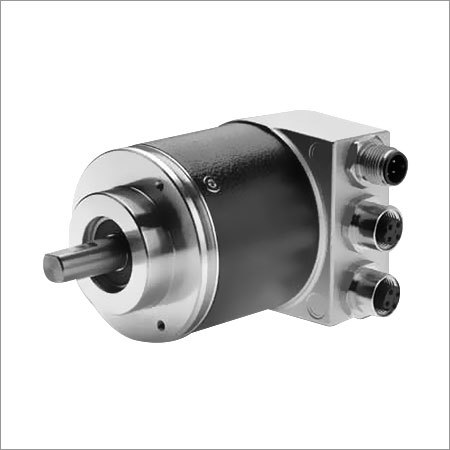
We are one of the leading suppliers and traders of Absolute Encoders for our hug clientele base. These make use of tested quality material and making as per the set industrial norms and standards. We offer these Absolute Encoders - Modular Bus Covers in different specifications to meet the demands of diverse clients. We conduct various quality inspections to make sure that no compromise is done with their quality. Clients can avail these from us at highly feasible prices in the market.
Features
- Encoder single- or multi turn / bus cover
- Optical sensing
- Resolution: single turn 13 bit, multi turn 16 bit
- Clamping or synchro flange
- CAN open / Device Net / Ether CAT/ Ether Net-lP /SAEJ 1939
- PROFINET /Power over Ether CAT / POWER LINK
- Profi bus/SSI
- Code continuity check optional by bus
Optional
- Incremental outputs and stainless steel design
Technical data - electrical ratings
Voltage supply 10...30 VDC
Reverse polarity protection Yes
Consumption w/o load 100 mA (24 VDC)
Initializing time (typ.) 250 ms after power on
Interfaces CANopen, DeviceNet,
EtherCAT, EtherNet/IP, PoE,
Profibus, PROFINET,
POWERLINK, SAEJ1939, SSI
User address Rotary switch in bus cover
(type-specific)
Steps per turn 8192 / 13 bit
Incremental output 2048 pulses A90B (optional)
Absolute accuracy 0.025
Sensing method Optical
Code Binary
Code sequence CW/CCW programmable
Interference immunity DIN EN 61000-6-2
Emitted interference DIN EN 61000-6-4
Programmable
parameters
Steps per revolution
Number of revolutions
Preset
Scaling
Rotational direction
Diagnostic functions Position or parameter error
Multiturn sensing
Status indicator DUO-LED integrated in bus
cover
Approval UL approval / E63076
GXAMW
Function Singleturn
GXMMW
Function Multiturn
Number of turns 65536 / 16 bit
| Technical data - mechanical design |
| Dimensions (flange) | 58 mm |
| Shaft type | 10 mm solid shaft (clamping flange) |
| 6 mm solid shaft (synchro flange) |
| Flange | Clamping or synchro flange |
| Protection DIN EN 60529 | IP 54 (without shaft seal) |
| IP 65 (with shaft seal) |
| Operating speed | 10000 rpm (mechanical) |
| 36000 rpm (electric) |
| Starting torque | 0.015 Nm (IP 54) |
| 0.03 Nm (IP 65) |
| Rotor moment of inertia | 20 gcm2 |
| Shaft loading | 20 N axial |
| 40 N radial |
| Materials | Housing steel |
| Flange aluminium |
| Bus cover: zinc die-cast |
| Operating temperature | -25...+85 C |
| -40...+85 C (optional) |
| Relative humidity | 95 % non-condensing |
| Resistance | DIN EN 60068-2-6 Vibration 10 g, 16-2000 Hz DIN EN 60068-2-27 Shock 200 g, 6 ms |
| Weight approx. | 650 g |
| Connection | Bus cover |
Unmatched Precision and DurabilityEngineered for accuracy, this absolute encoder delivers up to 16-bit resolution, providing 65,536 position steps per revolution. Its anodized aluminium housing and IP65 protection ensure resistance to dust, water, and mechanical shocks, making it tailored for industrial and robotic environments where stability and precision are essential.
Flexible Integration OptionsSupporting SSI, RS422, and parallel output signals, this encoder can easily interface with diverse control systems. Its radial cable entry, flange mounting, and direct drive type simplify installation. The built-in reverse polarity and short circuit protection enhance operational safety and longevity, minimizing downtime in automated setups.
FAQs of Absolute Encoders:
Q: How is this absolute encoder typically used within industrial and robotics applications?
A: This encoder is primarily used for precise position feedback in automation systems, robotic arms, and complex motion control setups. Its high resolution and digital control enable accurate monitoring and management of shaft position, essential for automation and robotic systems that require reliability and repeatability.
Q: What are the benefits of using an encoder with 16-bit resolution and shock resistance?
A: A 16-bit encoder provides extremely fine position granularity (65,536 steps per revolution), allowing for precise control and feedback in sensitive applications. Its shock-resistant design ensures continued performance in high-vibration or physically demanding environments, reducing the risk of component failure.
Q: When should I choose an optical encoder with SSI, RS422, or parallel output for my system?
A: Select SSI output for secure, high-speed serial communication in modern systems; RS422 is optimal for long-distance transmission within noisy environments, and parallel output is ideal when fast, simultaneous data is required. The choice depends on your equipment compatibility, distance requirements, and signal integrity needs.
Q: Where can these encoders be installed safely?
A: With an IP65 rating and robust construction, these encoders are suitable for installation in both indoor and outdoor locations exposed to dust, jets of water, and mechanical vibrations. Typical settings include factory automation lines, robotics cells, and industrial machinery in harsh operational environments.
Q: What process should be followed for integrating the encoder in a new system?
A: Start by mounting the encoder securely using the flange mount. Connect the radial cable output to your control devices compatible interface (SSI, RS422, or parallel). Ensure the power supply is within the 530V DC range, then calibrate the system for digital position feedback. Comprehensive wiring and grounding instructions should be observed for optimal safety and functionality.
Q: How does the maintenance-free design benefit long-term operation?
A: The maintenance-free, shock-resistant design reduces the need for regular servicing or replacement, which translates to lower operational costs and minimized downtimes. Its durable anodized aluminium body protects internal components, ensuring reliable performance throughout the encoders service life.





 Send Inquiry


 Send Inquiry